
About Myrna
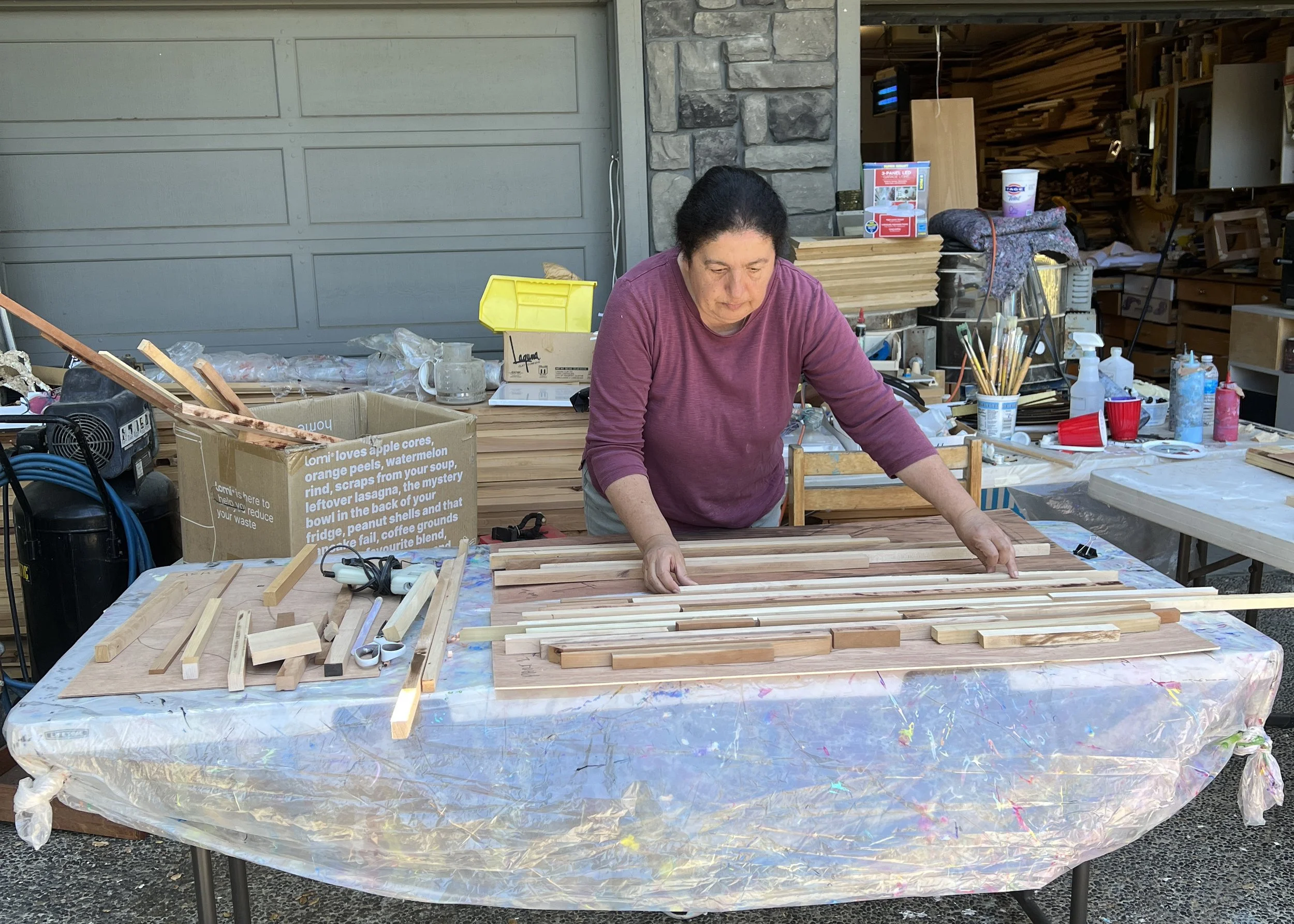
Myrna Ehrlich approaches her work through the lens of structure. Based in Cupertino, California, her background in mathematics, computer science, and architecture informs how she builds an image—layer by layer, system by system. For her, structure is not a constraint but a generative framework, a way to explore rhythm, repetition, and variation.
Born in Israel and raised in France, Myrna moved to the United States as a teenager. She studied mathematics and computer science and spent many years working as an engineer, writing software for nuclear power plants and developing cell phone security systems. Later, she returned to school to earn a Master’s degree in Architecture.
After a career rooted in technology, Myrna gradually shifted toward the arts. Her curiosity led her to experiment with a wide range of materials and processes, including watercolor, ceramics, glass, oil and acrylic painting, wire sculpture, papier-mâché, woodworking, and welding. This exploration reflects her desire to understand how things are built and how materials behave.
Today, each work begins digitally. Myrna manipulates street photography and geometric forms in CAD, constructing high-contrast compositions that may become laser-carved intaglio plates, precisely cut pochoir stencils, or intricate geometric papercuts. The grid often anchors the work, establishing order before it is tested, cut, layered, or printed.
Whether carving a plate, cutting paper, or constructing shallow “2.5D” environments from cardboard, she translates digital systems into tactile form. Positive and negative space, light and shadow, surface and depth are treated as architectural elements.
Her artistic path has also included ambitious experimental projects, such as a house made from more than 16,000 CDs, an infinity mirror room, a funhouse installation, and the construction of a large loom for local fundraisers. These projects reflect the same curiosity and problem-solving mindset that continues to guide her studio practice.
Across media, Myrna’s work reflects a dialogue between precision and improvisation—between engineering logic and the warmth of paper, wax, ink, and light. She invites viewers to slow down and look closely, discovering how small shifts within a system can create unexpected movement and quiet transformation.
